
How Kalibra Works
Continuous care, from data to daily action
From fragmented health data to continuous action.
Kalibra brings health data together, prepares it for clinician review, and turns approved plans into actions patients can follow.
Explore by workflow
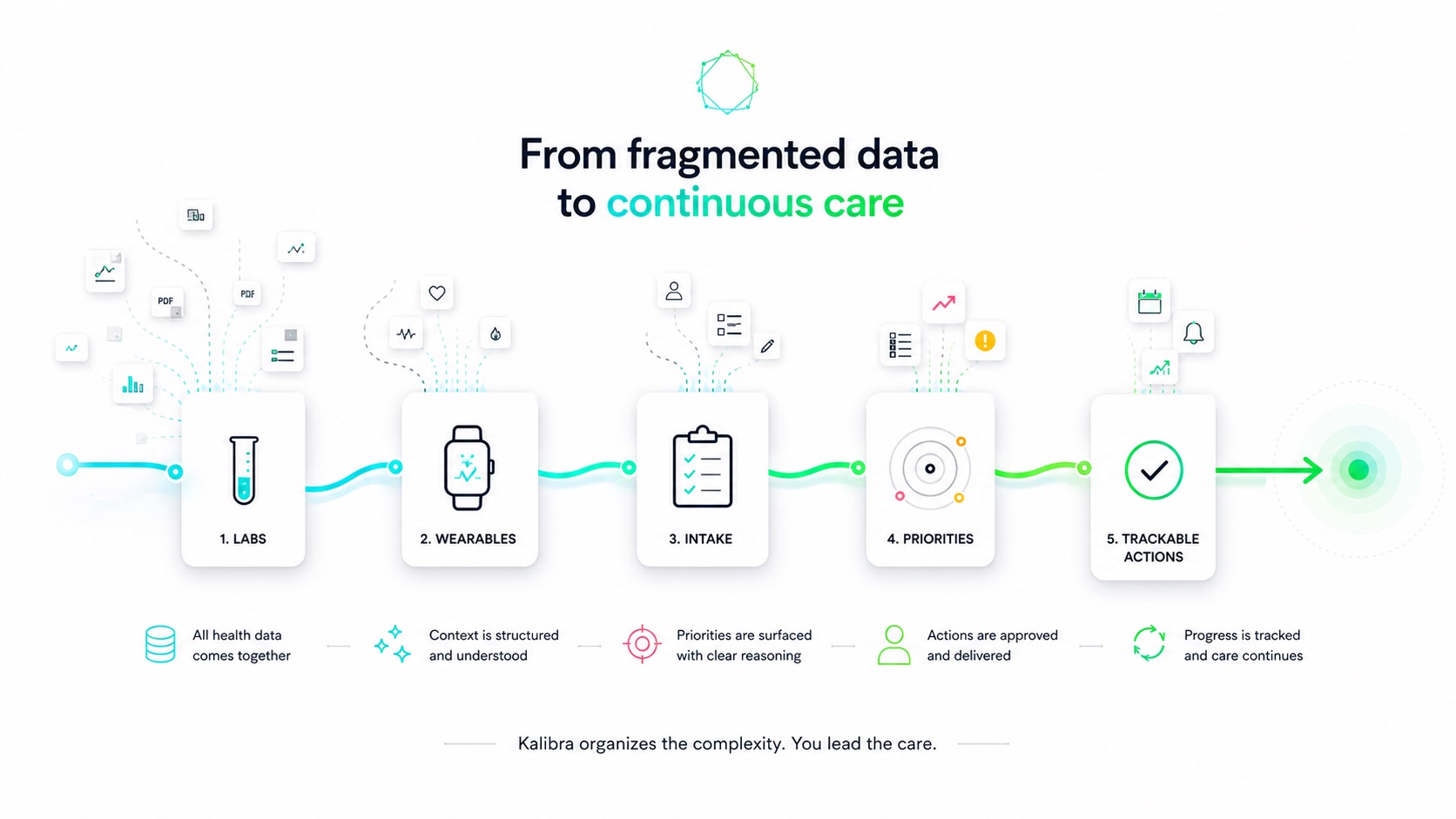
The workflow in plain English
Connect data
Labs, wearables, records, assessments, intake, check-ins, and protocol adherence come into one workflow.
Structure context
Kalibra turns scattered inputs into usable context while preserving source, timing, and quality.
Surface priorities
The system highlights areas worth review. Scoring is for workflow prioritisation, not diagnosis.
Support practitioner review
The clinician sees the reasoning and decides what to accept, edit, ignore, or override.
Track change
Approved actions move into the client experience, and follow-up becomes visible between visits.
A workflow for care before and after the visit.
Before Kalibra
Teams reconstruct context from PDFs, portals, dashboards, notes, and memory. The plan often becomes a static document.
With Kalibra
Data becomes prepared context. Priorities become reviewable. Approved plans become trackable action.
Clinician authority stays where it belongs.
Kalibra gathers, structures, scores, prioritises, drafts, reminds, tracks, and escalates. Humans retain judgement: diagnosis, interpretation, treatment decisions, and final approval.
Your EHR remains your system of record. Kalibra becomes the pre-consult intelligence layer around the patient journey.
See the workflow on a representative client journey.
Show us one patient journey. We will demonstrate how Kalibra prepares the information, supports your review and keeps the agreed plan visible between visits.