
Trust, Evidence and Governance
Trust, evidence and governance
Clinical decisions stay with your team.
Kalibra uses structured data, visible reasoning, human review, and clear limitations to support safer AI-assisted health workflows.
Explore by workflow
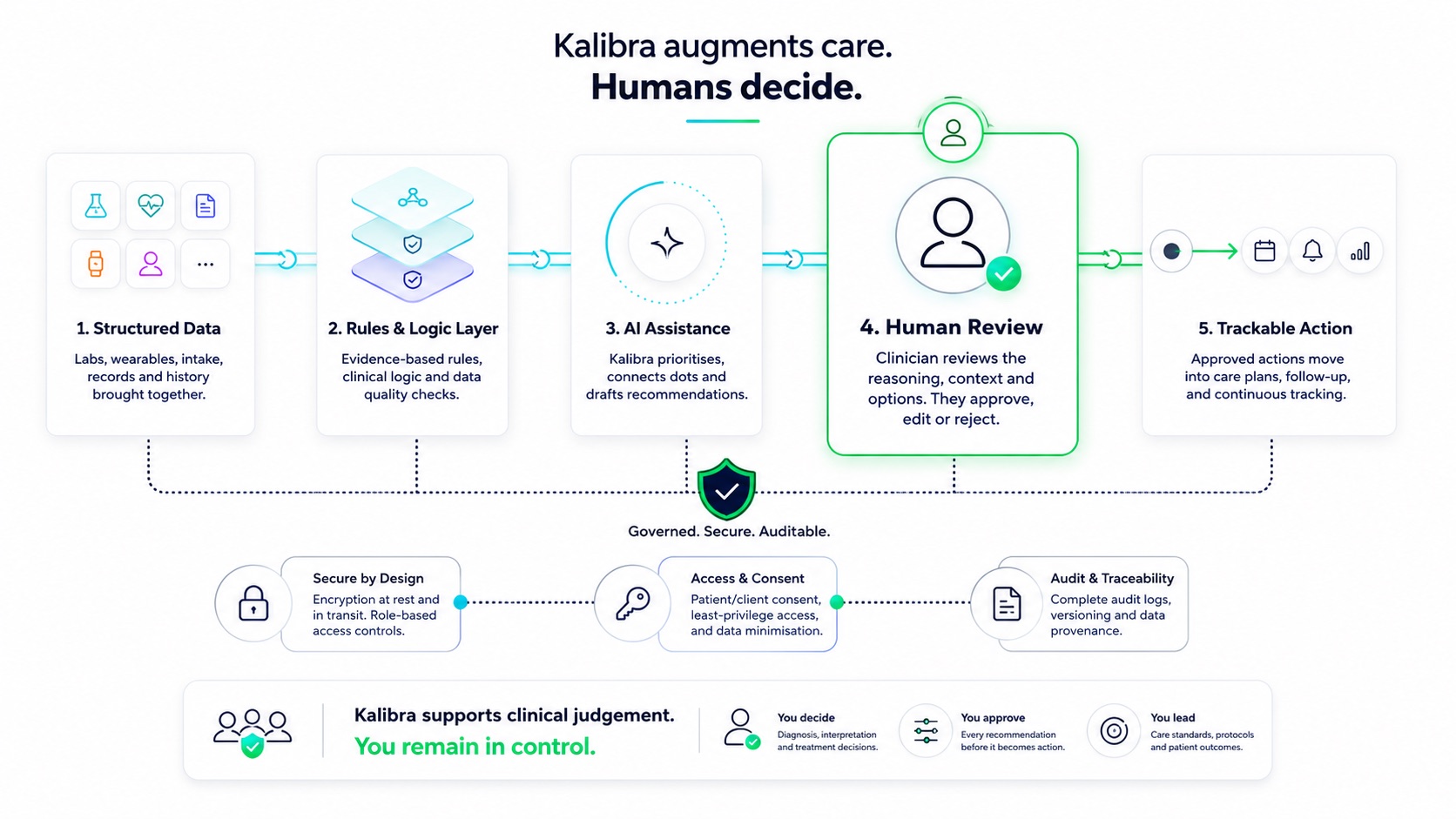
Kalibra routes, prioritises, and drafts. Humans decide.
Kalibra supports clinical workflows. It does not replace clinical judgement, issue autonomous diagnoses, or bypass qualified professionals.
How trust is designed into the workflow
Human decision authority
Clinicians retain responsibility for diagnosis, interpretation, treatment decisions, and final approval.
Visible reasoning
Kalibra should show why something was surfaced: markers, trends, rules, context, and sources.
Hybrid intelligence
Deterministic logic supports consistency and auditability. LLMs may support synthesis and wording.
Clear limitations
Not emergency care
Kalibra is not designed for urgent or emergency medical situations.
Not autonomous diagnosis
Outputs should be reviewed by qualified professionals where clinical decisions are involved.
Not autonomous prescribing
Recommendations require the appropriate human review, scope, and approval.
Security and governance areas
Data protection
- Access controls
- Encryption at rest and in transit
- Role-based permissions
- Consent where relevant
Clinical governance
- Clinician-in-the-loop review
- Output review and override
- Protocol approval workflows
- Audit trail and provenance
FAQ
Is Kalibra a medical device?
Regulatory requirements depend on the market and deployment. Discuss your intended use with us during scoping; Kalibra does not provide autonomous diagnosis or treatment.
How does Kalibra reduce hallucination risk?
It is not designed as a free-form chatbot. It uses structured data, deterministic logic where appropriate, visible reasoning, and human review.
Can a clinician override Kalibra?
Yes. The clinician can approve, edit or reject proposed next steps and remains responsible for clinical decisions.
Request the security and governance pack.
For procurement, partnership, or clinical governance review, request the supporting materials most relevant to your use case.