A high benchmark score can tell you that an AI system performed well on a defined test. It cannot, by itself, tell you whether the system will help your clinicians, fit your workflow or remain safe after it changes.
That distinction matters because a healthcare organisation is rarely buying a model in isolation. It is accepting a change to work, responsibility and risk. The relevant unit of evaluation is therefore the deployed system: the model, its instructions, the evidence it can retrieve, the tools it can use, the people who review it and the rules that govern what happens next.
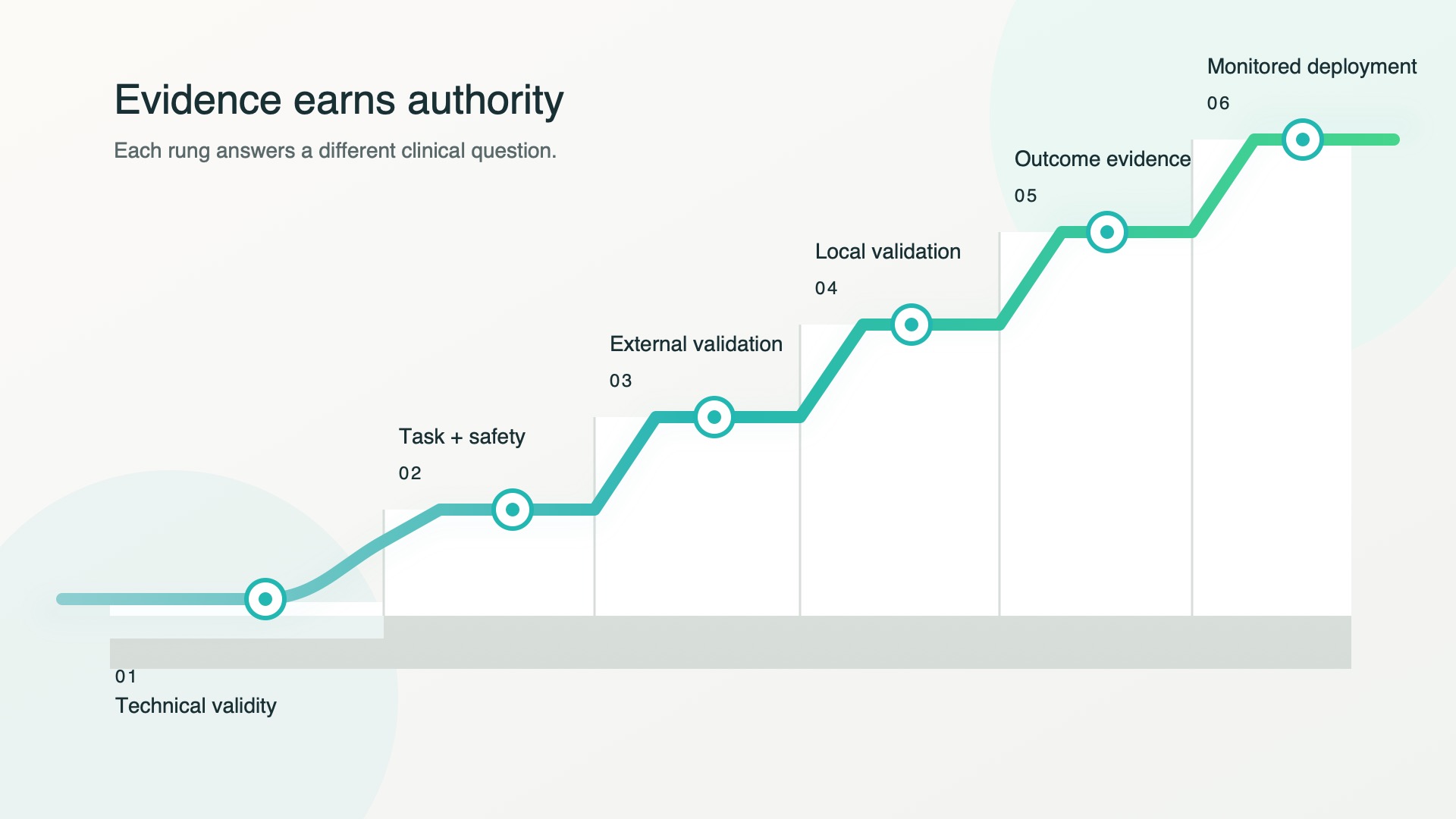
Clinical AI evidence should build in stages. Each stage answers a different question. None can be skipped simply because the technology looks impressive in a demonstration.
A benchmark score is not a clinical outcome
Benchmarks are useful. They allow teams to compare performance on a fixed task, establish a technical baseline and detect obvious regression. But they are deliberately narrower than clinical practice.
A benchmark usually removes much of the context that makes healthcare difficult: incomplete records, changing populations, unusual presentations, local documentation habits, time pressure, competing priorities and the cost of an unnecessary alert. A system may answer curated questions accurately while failing to recognise when the record is insufficient, when a recommendation falls outside its authority or when a clinician needs a concise explanation rather than another page of output.
This is why accuracy is only one part of the proof. A credible evaluation must also examine failure recognition, workflow fit, benefit and harm, accountability, and performance over time.
The six-level clinical AI evidence ladder
Each rung answers a different question. Evidence higher on the ladder does not erase a weakness below it.
| Evidence rung | The question it answers | Proof to ask for | What it does not prove |
|---|---|---|---|
| 1. Technical validity | Can this exact configuration perform its defined task? | Version-bound test report, representative evaluation set, regression suite | Clinical usefulness or safe failure |
| 2. Task and safety validity | Is it safe enough for this bounded task? | Failure-mode tests, known limits, escalation and recovery evidence | Performance in another setting |
| 3. External validation | Does performance travel beyond development data? | Independent validation, subgroup results, exclusions | Fit with your workflow |
| 4. Local prospective validation | Does it work safely and usefully here? | Silent-mode results, burden and override analysis, stop criteria | Better outcomes |
| 5. Outcome evidence | Does use improve something decision-relevant? | Prospective or comparative evaluation, benefit-harm analysis | Continued performance after change |
| 6. Monitored deployment | Can you detect when the evidence no longer holds? | Version traceability, drift and incident monitoring, rollback tests | Permanent trust |
Level 1: Technical validity
The first rung establishes that the configured system works as intended.
For a conventional model, this may include discrimination, calibration, sensitivity, specificity or task accuracy. For a generative or agentic system, it must also include the surrounding configuration: model and provider, prompts, policies, retrieval sources, tool permissions, output schema and tenant-specific settings.
The proof artefacts should be inspectable. Examples include a version-bound test report, a representative evaluation set, retrieval-grounding checks, permissions tests and a regression suite.
This rung answers: Can this exact configuration perform its defined task?
It does not answer whether the task is clinically useful, whether the system behaves safely at the edges or whether the result will hold in a different setting.
Level 2: Task and safety validity
The second rung tests the bounded clinical task and its failure behaviour.
Clinical systems need to do more than produce a correct answer on average. They need to recognise when the evidence is missing, contradictory or outside scope. Evaluation should therefore include difficult and representative cases, explicit limits, abstention, escalation, containment and recovery.
For example, an AI-generated patient summary should be tested not only for factual accuracy, but also for omitted qualifiers, confused timelines, unsupported causal language and failure to distinguish a patient report from a verified clinical finding. An action-support system should show where authority stops and when human approval is required.
Useful proof artefacts include a safety case, red-team results, known-limitations register, failure-mode tests and documented escalation paths.
This rung answers: Is the system safe enough for this bounded task, including when it is wrong or uncertain?
Level 3: External validation
The third rung asks whether performance travels beyond the development environment.
External validation uses held-out or independent data and should reflect the populations, sites, devices and conditions in which the system may be used. It should report more than a single headline metric. Relevant subgroup results, confidence intervals, calibration and failure patterns are often more informative than a pooled average.
External validation reduces the risk that a system has learned the quirks of one dataset or one institution. It does not prove that the system will fit your local workflow. A result can travel statistically while failing operationally because the available data, clinical roles, thresholds or follow-up processes differ.
Useful proof artefacts include an independent validation report, population and site descriptions, subgroup analysis and a transparent account of exclusions.
This rung answers: Does performance generalise beyond the original test environment?
Level 4: Local prospective validation
The fourth rung moves the system into the intended workflow without immediately giving it unrestricted authority.
A silent-mode or staged prospective evaluation lets an organisation observe how the system behaves against live local conditions. It can reveal data gaps, false alarms, alert burden, latency, clinician acceptance, overrides, recovery problems and unexpected interactions with existing work.
This is where a technically strong system may prove unsuitable. An alert can be accurate and still arrive too late. A summary can be complete and still take longer to verify than the current process. A recommendation can be sensible but directed to someone who lacks the authority or time to act.
Local validation should have a predefined protocol, named owners, acceptance thresholds and stop criteria. It should compare the system with a credible baseline rather than relying on favourable anecdotes.
Useful proof artefacts include the local evaluation protocol, silent-mode results, workflow observations, override analysis and a readiness decision.
This rung answers: Does the system work safely and usefully in our setting?
Level 5: Outcome evidence
The fifth rung tests whether the system improves something that matters.
The outcome may be clinical, operational or human. Depending on the use case, it could include time to review, follow-up completion, medication reconciliation quality, avoidable duplication, clinician workload, patient comprehension or a defined health outcome.
The choice of outcome should match the system's claim and authority. A tool designed to reconstruct a patient story should not be judged by a distant clinical outcome it cannot reasonably control. Equally, a system that claims to improve care should not rely only on engagement or output volume.
Outcome evaluation should define the baseline, time horizon, benefit-harm balance and attribution limits. It should also look for displaced work: time saved in one role may create more work elsewhere.
Useful proof artefacts include a prospective study, comparative service evaluation, implementation study and transparent benefit-harm analysis.
This rung answers: Does using the system improve a decision-relevant outcome without unacceptable harm or burden?
Level 6: Monitored deployment
The final rung is not the end of evaluation. It is the operating discipline that keeps evidence current.
Clinical AI systems can change because of a new model, prompt, policy, retrieval corpus, tool, threshold, integration or population. Even when the software does not change, clinical practice and local data can drift around it.
Monitored deployment therefore requires version traceability, performance and subgroup monitoring, incident review, user feedback, change control, release gates and the ability to stop or roll back. Material changes should return to the appropriate evidence rung rather than inheriting trust from an earlier version.
Useful proof artefacts include a live monitoring plan, version and change register, incident log, drift dashboard, periodic review record and tested rollback procedure.
This rung answers: Can the organisation detect when the evidence no longer supports the deployed system?
Accuracy without signal becomes noise
Clinical teams do not experience an alert as a sensitivity statistic. They experience it as an interruption, a decision and a possible obligation to act.
This makes alert burden part of the evidence. A system that identifies more possible risks can still reduce safety if it overwhelms attention, duplicates existing controls or sends low-value work to the wrong person. Evaluation should examine positive predictive value, actionability, timing, duplication, override patterns and the consequences of missed and unnecessary alerts.
The question is not simply whether the system detected something. It is whether the right person received a useful signal at a point when an appropriate action was possible.
Evidence belongs to a version, not a product name
Clinical AI evidence should be tied to the system that was actually evaluated.
For modern AI, that means recording more than a product version. The evaluated configuration may include the underlying model, provider, prompt, system policy, tools, retrieval corpus, clinical content version, output schema, thresholds, user role and authority setting.
If any of these changes materially, the evidence may no longer transfer in full. A vendor should be able to explain which changes trigger regression testing, local revalidation, clinical review or a temporary reduction in authority.
Without that traceability, organisations can end up operating a system that is similar to the one evaluated but not meaningfully the same.
Twelve questions for buyers
Use these questions to locate the evidence, not just the claims:
- What exact task and user is the system evaluated for?
- Which deployed configuration does the evidence cover?
- What is the benchmark population, and how does it differ from ours?
- How does the system behave when information is missing or contradictory?
- When must it abstain or escalate to a human?
- What independent and subgroup validation has been completed?
- What local prospective evaluation is expected before authority expands?
- Which workflow, patient or operational outcomes will be measured?
- How are false alarms, overrides and displaced work assessed?
- Which changes trigger regression testing or revalidation?
- How are incidents, drift and subgroup performance monitored?
- Who can pause, roll back or reduce the system's authority?
Use these questions as a practical review checklist during evaluation, procurement and local validation.
The Kalibra perspective
Kalibra treats evidence and authority as linked. A system should receive only the access and authority supported by its current evidence, with clinicians retaining control of diagnosis, treatment decisions and consequential action.
That means starting with bounded, reviewable work; making provenance and uncertainty visible; learning from real disposition, edits, overrides and follow-through; and expanding authority only when the relevant evidence rung has been met. The aim is not autonomous theatre. It is a safer, more useful path from fragmented information to a reviewable patient story, a better decision and accountable follow-through.
From impressive output to defensible use
The proof problem in clinical AI is not a shortage of metrics. It is the tendency to let one kind of evidence answer a question it was never designed to answer.
Benchmarks establish a technical starting point. Safety testing examines failure. External validation tests generalisability. Local prospective work tests fit. Outcome evidence tests value. Monitoring keeps the conclusion current.
Healthcare organisations should expect all six, in proportion to the system's risk and authority. The goal is not to delay useful technology. It is to know what has been proved, what remains uncertain and who is responsible for the next step.
Continue the series
- Browse the Clinical AI guide series for the complete six-part collection.
- Read How to Evaluate an AI Agent for a Functional or Longevity Clinic for the procurement and demonstration checklist.
- Read Human-in-the-Loop Is Not Enough: Five Levels of Authority for Clinical AI for the control model behind safe deployment.
- See How Kalibra works and the Kalibra trust model for the platform and governance context.
- Contact Kalibra to discuss a governed path from local evaluation to monitored deployment.
Frequently asked questions
What is clinical AI validation?
Clinical AI validation is the process of testing whether a specific system performs its intended task safely and usefully. It may include technical testing, safety and failure-mode evaluation, independent validation, local prospective testing, outcome evaluation and post-deployment monitoring.
Is regulatory approval enough to deploy clinical AI?
Regulatory status is important, but it does not by itself establish local workflow fit, local data compatibility or the effect on burden and outcomes. Organisations still need proportionate local evaluation, implementation controls and monitoring.
Why is local testing needed after external validation?
External validation tests whether performance travels beyond the development setting. Local testing examines whether the system works with your population, data, roles, pathways, thresholds and escalation processes.
Does a material system update require revalidation?
It may. Changes to the model, prompt, policy, tools, retrieval sources, thresholds, integration or authority can affect the evaluated behaviour. The change-control plan should define which evidence gates must be repeated.
Sources
- International Medical Device Regulators Forum. Software as a Medical Device (SaMD): Clinical Evaluation. 2017. https://www.imdrf.org/sites/default/files/docs/imdrf/final/technical/imdrf-tech-170921-samd-n41-clinical-evaluation_1.pdf
- NICE. Evidence standards framework for digital health technologies. https://www.nice.org.uk/corporate/ecd7
- Vasey B, et al. Reporting guideline for the early-stage clinical evaluation of decision support systems driven by artificial intelligence: DECIDE-AI. BMJ. 2022;377:e070904. https://www.bmj.com/content/377/bmj-2022-070904
- US Food and Drug Administration. Good Machine Learning Practice for Medical Device Development: Guiding Principles. https://www.fda.gov/medical-devices/software-medical-device-samd/good-machine-learning-practice-medical-device-development-guiding-principles
- US Food and Drug Administration. Marketing Submission Recommendations for a Predetermined Change Control Plan for Artificial Intelligence-Enabled Device Software Functions. 2024. https://www.fda.gov/regulatory-information/search-fda-guidance-documents/marketing-submission-recommendations-predetermined-change-control-plan-artificial-intelligence
- National Institute of Standards and Technology. AI Risk Management Framework. https://www.nist.gov/itl/ai-risk-management-framework
This guide is educational and does not replace clinical, legal, regulatory or information-security review. Product requirements and evidence expectations should be adapted to the use case, jurisdiction, risk and authority of the deployed system.