
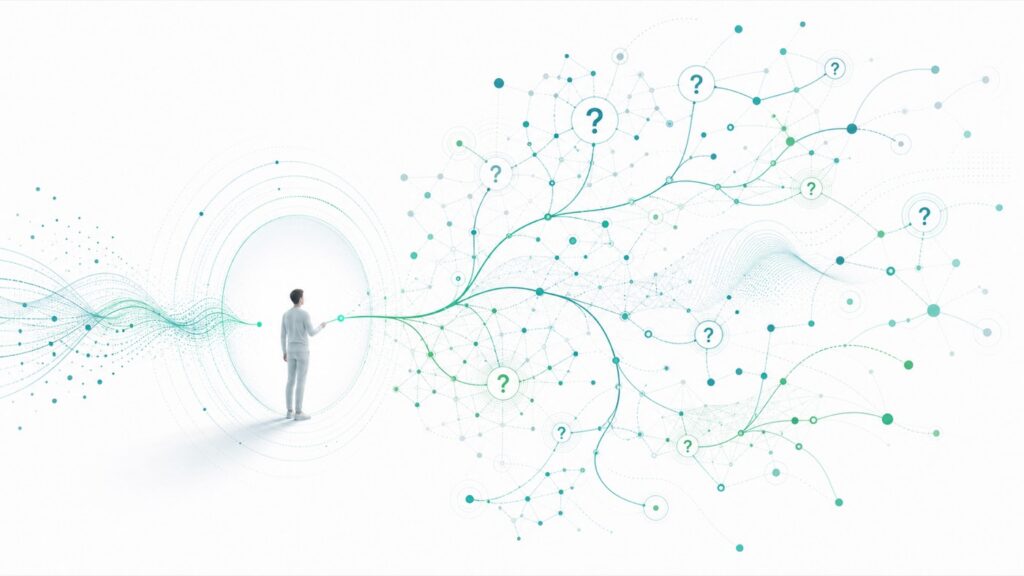
We’re already swimming in Slop. What if, instead of answer factories, we built curiosity amplifiers?
We obsess over which model gives the best answers in the race for AI supremacy. But what if that’s the wrong metric altogether?
We benchmark LLMs on speed, coherence, and factuality — essentially, how well they answer. Yet the most valuable commodity might be hiding in plain sight: the questions themselves.
Think about it: While answer quality is rapidly becoming commoditised (with costs trending toward zero and open-source models closing the gap), who’s capturing the pulse of human curiosity in real time?
The Economics of Questions
- The company with the most interesting dataset of human questions may own the future.
- Every query reveals patterns of thought that no traditional dataset could capture
- Questions map the evolution of human curiosity with unprecedented granularity.
The Industrial Revolution didn’t start with “How do we improve horses?” It began with “What if we didn’t need them?”
True knowledge isn’t about isolated facts but connections between ideas. We don’t need AI to replace human curiosity; we need it to enhance our capacity to question, connect, and create.
Consider some core human truths:
- Art exists in the space where understanding hasn’t yet arrived
- Mystical experiences through self-exploration are an off-button for the anxious self
- Life is a hypothesis to be tested, not an argument to be proved
The real AI revolution won’t happen when machines perfect their answers. It will happen when they transform our questions. Change your questions, change your life.
In ten years, the most valuable AI assets won’t be the models that answered best but those that listened best.
Don’t just examine what people believe if you want to glimpse the future. Study what they’re asking.
The questions we never thought to ask before—that’s where the magic happens.
What questions are you not asking?
Further reading: The Jarvis Principle: Reclaiming Your Attention from the AI Swamp · The AI Mirage: Why Healthcare Can’t Run Before It Crawls · The Heart Outside the Body, the Brain in the Cloud