
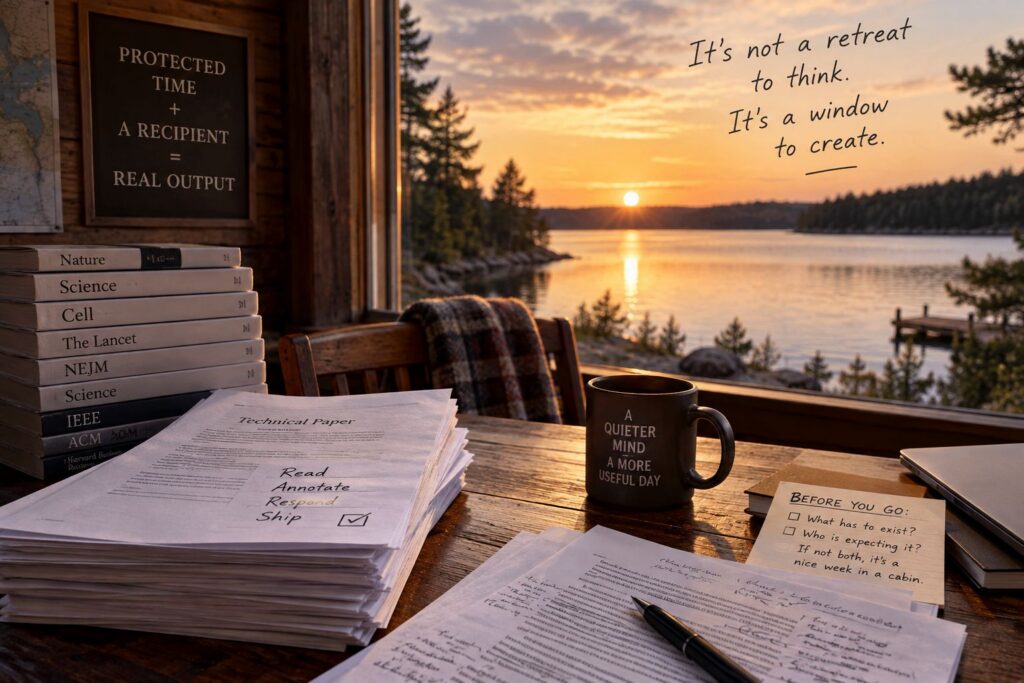
Twice a year, Bill Gates disappeared into a waterfront cottage. No visitors. Not staff, not family. A caretaker left two meals a day at the door.
Everyone copies the cottage.
Almost nobody copies what he did on the way out. He read up to 100 technical papers in a week, annotated every one by hand, and sent his responses back to the people who wrote them. One of those weeks produced the memo that turned Microsoft towards the internet.
He didn’t go away to think. He went away to produce something that had a recipient and a date.
That is the whole difference, and it is not a small one.
Most protected time has no recipient. The offsite that ends in agreement and no owner. The course you finished and never used. The notes app with four thousand entries and not one changed decision. The reading, the retreat, the thinking day, the sabbatical.
None of that failed for lack of protection. It failed because nothing had to come back.
And the protection is real, which is what makes this worth getting right. Gates could not have read a hundred papers with his calendar running. You do need the wall.
But a wall with no door is just a well-defended way of not finishing.
So before you block out the time, write down two things. What has to exist when you come out. And who is expecting it.
Not a feeling of clarity. A thing, and a person waiting for it.
If you cannot name both, you haven’t booked thinking time. You have booked a nice week in a cabin.