Someone has mentioned peptides to you in the last few weeks. And as a category, peptides have been a runaway success. Insulin is a peptide. So is GLP-1. Between them they have rewritten the treatment of two of the largest disease burdens on earth.
That success is now being borrowed.
Because “peptide” describes the size of a molecule, not the weight of its evidence. It covers insulin. It also covers whatever is being sold in a forum thread beside a photograph of a vial. The word turns up carrying credit it earned somewhere else.
And the pitch that comes with it is usually a mechanism. A receptor, a cascade, a named enzyme. Explained well, a pathway feels like it has already been tested, because it has the shape of a finished argument. The fluency does the work the evidence should be doing.
Here is why that is dangerous.
In the 1980s, cardiologists reasoned that irregular heartbeats after a heart attack predict sudden death, and drugs existed that suppressed them. So suppress them, and fewer people die. Airtight. The drugs were approved and widely prescribed.
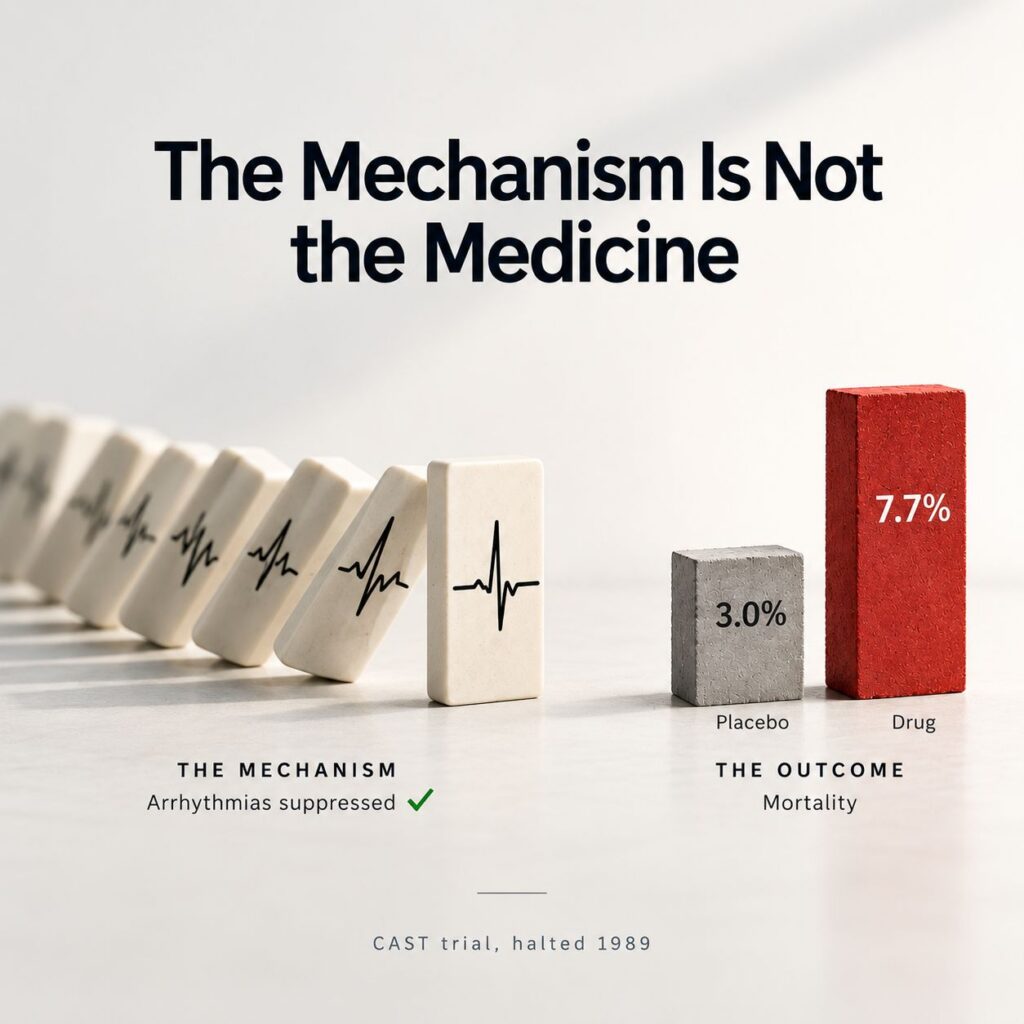
The trial was stopped early, in 1989, because of the death rate: 7.7% of patients on the drugs died, against 3.0% on placebo.
The drugs worked. They suppressed the arrhythmias exactly as predicted. The mechanism was confirmed, and the patients died anyway.
Mechanism explains the bet. Outcome settles it.
So what separates the peptide that rewrote diabetes care from the one in the forum thread? Peter Attia puts it well: real drug development narrows its claims over time, and bad science expands them.
Semaglutide’s claims expanded too — diabetes, then obesity, then cardiovascular outcomes. The difference is that each step arrived with a trial attached. Claims are allowed to grow. They are meant to grow at the speed of the evidence.
Plenty of other peptides have been repositioned across nearly every therapeutic area imaginable without a published randomised human trial for a single one. Yes, many cannot be patented, so nobody has a billion-dollar reason to fund one. That explains missing industry studies. It does not explain missing academic ones, and it does not explain the widening.
The question is never whether a claim makes sense. Most of them make sense.
It is whether the promises grew faster than the proof.